Ko Te Pōhewa Te Whatu O Te Awe: Vision Is The Eye Of The Soul
Te Takapau a Maui Tikitiki a Taranga
For more than five decades (1973 - 2026) I have pursued a lifelong search into the foundations of IO, traditional IO Tohungatanga, and different Traditional IO Whare Wānanga.
My journey did not begin in academia.
It began in 1975 through childhood experiences of Te Ao Wairua at three years old that awakened questions within me which would guide the course of my life.
Who were the ancient Tohunga?
How did they acquire their knowledge?
What is the source of the spiritual mana they possessed?
How do we restore this again?
What was taught within the Traditional Whare Wānanga?
And why have these ancient systems largely disappeared from the world around us?
Those questions became a fifty-year search and still continue today.
Over the course of that search I travelled throughout Aotearoa, Te Moana Nui a Hiva, Tahiti, Hawaii, Rapanui, Chile, America, Japan, Italy, Africa, and Canada.
I sought out Tohunga from many traditions, studied manuscripts, researched whakapapa, and explored both traditional and contemporary pathways of knowledge.
My journey also intentionally led me through all three Māori Indigenoud Wānanga institutions in Aotearoa.
I worked within Te Wānanga o Aotearoa, completed a Bachelor of Arts in Mātauranga Māori, 2011, at Awanuiārangi,
and an unpublished PhD, Towards a New Vision Of The Traditional Whare Wānanga in a Contemporary Context, 2015, through Te Whare Wānanga o Awanuiārangi,
and completed Master's studies, Tāhūhū Mātauranga Māori, Te Ahurewatanga Ō Te Tohunga Ahurewa - The Restoration Of Tohunga Ahurewa 2011, through Te Wānanga o Raukawa.
These experiences allowed me to examine deeply both modern indigenous academic education, and the foundations of the Traditional Whare Wānanga.
One of the conclusions arising from this work was that modern indigenous wānanga institutions, and Traditional Whare Wānanga are not the same thing.
A Ahorangi, Amorangi, Amokura, Ariki, Ruanuku, Amokapua, and a Dr or Professor are not the same thing.
Qualifications from the Traditional Whare Wānanga are not transferable to modern academic institutions and vice-versa.
A doctorate was not my final destination.
It was one stage of a much larger journey to discover whether the true knowledge of the Traditional Whare Wānanga lay within academic places.
It didn't.
During my academic studies, in 2013 I returned home to Hokianga for fifteen years and intensified my search.
Even though I had been exposed to Tohungatanga through all my whakapapa lines from Rotorua,
Tauranga, Whakatāne, Rotoiti, Te Teko, I returned to Waihou, Hokianga to embody my great-grandfather's
Te Ngaropo Tāwio Pouroto's Tohunga legacy through Te Wānanga Ō Hokianga, 1800s.
Over those years I travelled extensively throughout Te Tai Tokerau, working alongside approximately thirty Tohunga from Ngāpuhi, Hokianga, and Te Tai Tokerau.
The remaining fifteen Tohunga were nationally based and internationally recognised.
At the same time I read many Māori manuscripts.
The main one being the fifteen manuscript ledger books known as the Kaamira Manuscripts, late 1800s to 1958, kindly shared with me by Pita Kāmira in 2020,
which preserved knowledge extending across many generations from Hawaiki to Hokianga, 900AD to 2026.
Together, these sources contributed to the restoration of the Traditional Whare Wānanga model based upon,
the foundations handed down through Tohunga, manuscripts, whakapapa, direct transmission, lived experience, responsibility, and service.
In 2018, Te Whatupungapunga Whare Wānanga a Nukutāwhiti was reopened in Waihou, Hokianga,
and sat on the shoulders of thirty Ngāpuhi, Taitokerau and Hokianga Tohunga with the Te Toki O Kupe: Tauira Ata a toki Nukutāwhiti brought on,
Ngātokimatawhaorua was present at the opening with the permission from Rangatira kaumātua Wallace Wihongi.
This restoration was aligned with the traditional model and remains one of the most significant achievements in Taitokerau of this time.
There hasn't been any reopening of a Traditional Whare Wānanga similar to it in these modern times, or the last 50 years.
It is only academic institutions of learning now that are opened today.
Central to this restoration was the re-establishment of IO as the spiritual foundation of the Traditional Whare Wānanga, and the reopening of the Rangitūhaha in Taputapuātea in 2025.
The thirteen dimensions of IO.
After Te Whatupungapunga in 2018,
came Te Whare Kokorangi in 2024,
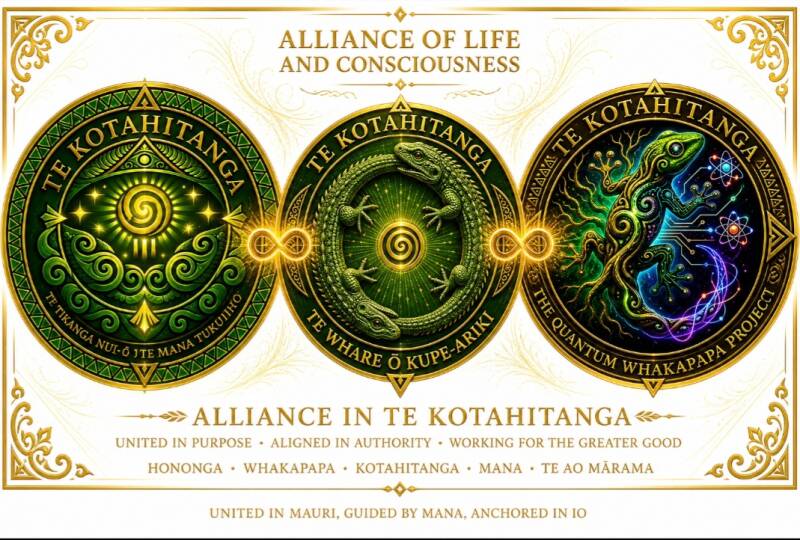
after that came Te Whare Ō Kupe-Ariki in 2024,
and Ngā Manukura Ō Te Wakaminenga, 2022.
then came Te Whare Atua Ō IO in 2025,
These Whare continue today.
The passing of respected academic and cultural leaders such as Tā Hirini Moko Mead, Professor Whatarangi Winiata, Tā Tāmati Reedy, all passing in 2026,
and Amokura Porohau Ruka Te Korakora of Waitaha, being a traditional Tohunga himself, has prompted reflection on why these indigenous academic scholars didn't focus on, or restore the Traditional model of the Whare Wānanga.
Hence, the different pathways through which knowledge is carried and transmitted.
Each contributed significantly to the academic and cultural development of our people.
My path has been about and is dedicated to the restoration of IO, Traditional IO Tohungatanga,
the Traditional IO Whare Wānanga, Te Whare Ariki, and the foundations from which these traditions emerged.
This website exists to preserve that journey, share those reflections, and continue the transmission of knowledge for future generations.
There is an invitation for anyone interested to participate in real time in these Traditional IO Whare Wānanga through this website, and organised explorative live-in Wānanga.
Nau mai! - Welcome
There are no fees, only koha contributions when attending to help cover travel, food, and associated koha.
Our latest project is to write a trilogy of books sharing the pathway, experiences, tribulations,
and insights gained through the journey of restoring IO, the restoration of Traditional IO Whare Wānanga, and IO Traditional Tohungatanga,
And to release a series of video documentaries about the entire journey.
In closing, this is only the beginning.
Some would say that after seven hundred and fifty generations have passed, from IO to Kupe-Ariki it is not possible to restore the Traditional IO Whare Wānanga or Traditional IO Tohungatanga as it was.
That momo (type) of Tohunga, or that type of mana atua (spiritual authority) of the Traditional Whare Wānanga, is gone.
We could never match it.
I feel differently.
I feel like we could offer something unique.
The reopening of Te Whatupungapunga Whare Wānanga, the restoration of IO as the spiritual foundation of the Traditional Whare Wānanga,
the reopening of Rangitūhaha, and the re-establishment of Traditional Tohungatanga are not the end of the journey, rather, merely the beginning.
They are the foundations for what comes next.
Everything we are working on now is already beyond what our Ariki, Rangatira and tūpuna imagined.
Te Whakatinanatanga - The Embodiment
The next stage is embodiment.
It is the living expression of the knowledge, wisdom, responsibility, healing, discipline, and service carried within these traditions.
For more than fifty years I have searched for these foundations and gained great insights.
Today that search continues with a new purpose, and a new vision without limitations, in order that we realise our greatest potential.
Not simply to preserve the knowledge. Not simply to teach the knowledge.
But to embody it
So our job then, is to go from philosopher, to initiate, to master.
From knowledge, to experience, to wisdom.
From mind, to body, to soul.
From thinking, to doing, to being.
From learning it with our head, to applying it with our hands, to knowing it in our heart.
To being and embodying it in our soul.
Stillness.
Believing.
Behaving.
Becoming.
Embodying.
Ko Te Pōhewa Te Whatu O Te Awe. Vision Is The Eye Of The Soul.